How the 1637 Tulip Mania Actually Happened (and What the Data Shows)
The real story of history's most famous bubble: when tulip bulbs briefly traded for more than houses in the Dutch Golden Age. What actually happened, and what does modern research reveal?

Video Coming Soon
The documentary for this article is currently in production. Subscribe to be notified when it's released!
Subscribe on YouTubeIn the winter of 1637, a single tulip bulb—a brown, onion-like thing you could hold in your palm—was valued at more than many skilled workers in Holland could earn in several years. Then, in the space of a few days in early February, the market for those bulbs simply stopped.
For nearly two centuries, this story has been told as the ultimate warning about greed: ruined merchants, people trading houses for flowers, a whole nation gone mad. But when historians and economists went back to the archives and the actual price records, they found something stranger, and far more interesting. This is how Tulip Mania actually happened, and what the data really shows.
A Flower From the Ottoman Empire
Tulips are not native to the Netherlands. They came from Central Asia by way of the Ottoman Empire, where they were already a celebrated garden flower. In the mid-fifteenth century, European diplomats and botanists began sending bulbs and seeds west. The ambassador Ogier Ghiselin de Busbecq is often credited with sending some of the first tulips to Vienna.
The key figure for the Dutch story is the botanist Carolus Clusius. In 1593, he took up a post at the University of Leiden and planted tulips in its new botanical garden. Bulbs from his collection spread—sometimes, according to legend, by theft—into the gardens of wealthy Dutch collectors.
The Dutch Republic in the early seventeenth century was the richest trading society in Europe. Amsterdam merchants financed voyages to Asia through the Dutch East India Company, and a growing class of prosperous townspeople wanted ways to display their taste. A rare flower, painted in watercolor albums and admired in private gardens, fit perfectly.
The Virus That Made Tulips Priceless
The most prized tulips were not the plain red or yellow ones. They were the “broken” tulips: flowers with flame-like streaks and feathers of color on white or yellow petals. Collectors grouped them into classes like the Rosen (red or pink on white), the Violetten (purple or lilac on white), and the rarest of all, the Bizarden (red or brown on yellow).
Nobody at the time understood why a bulb would suddenly produce these spectacular patterns. We now know the cause was a virus, spread by aphids, that disrupts the pigment in the petals and also weakens the bulb. That had a crucial economic consequence: broken bulbs reproduced slowly, through small offsets, and could not be reliably grown from seed. Supply was painfully limited.
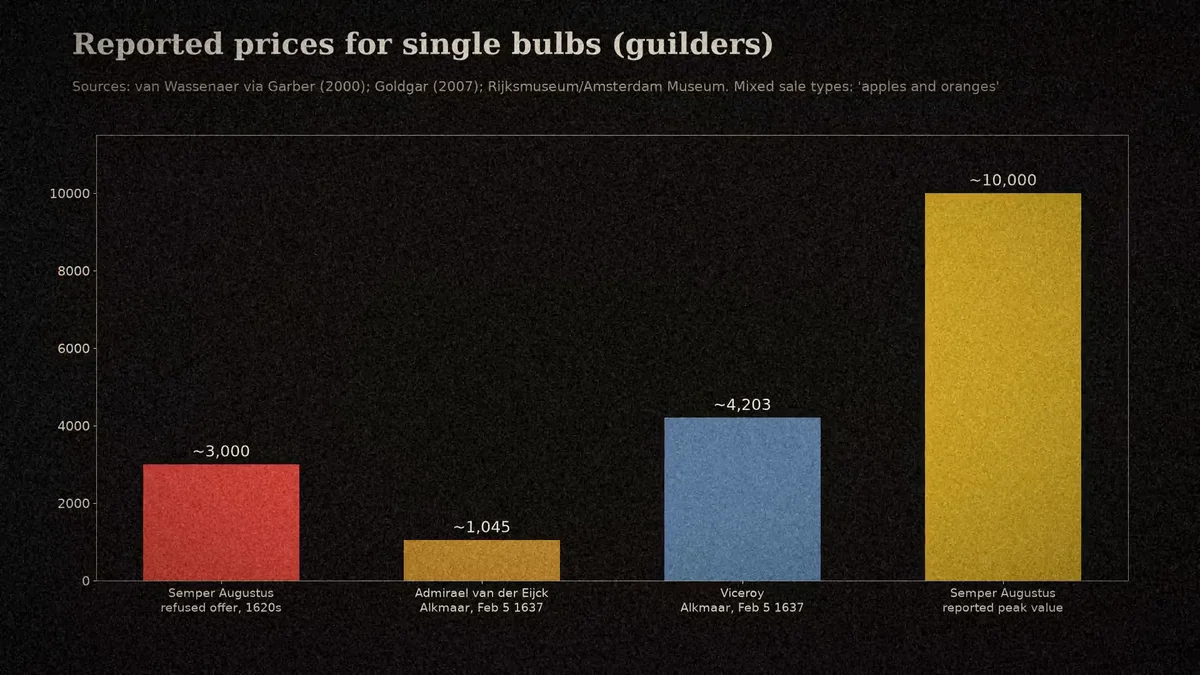
The most famous of them all was the Semper Augustus: white, with crimson flames. In the mid-1620s, a contemporary chronicler, Nicolaes van Wassenaer, reported that its owner had refused an offer of thousands of guilders for a single bulb. Only a handful were said to exist. At the peak of the mania, sources put its value at around ten thousand guilders—enough to buy a fine house on an Amsterdam canal.
How Tulips Were Actually Traded
To understand the crash, you have to understand the calendar. Tulips bloom for about a week in April or May. Between June and September, the bulbs can be lifted out of the ground, so that is the only time a bulb can physically change hands. For the rest of the year, buyers and sellers could only sign promises: contracts to deliver a bulb when it was dug up the following summer.
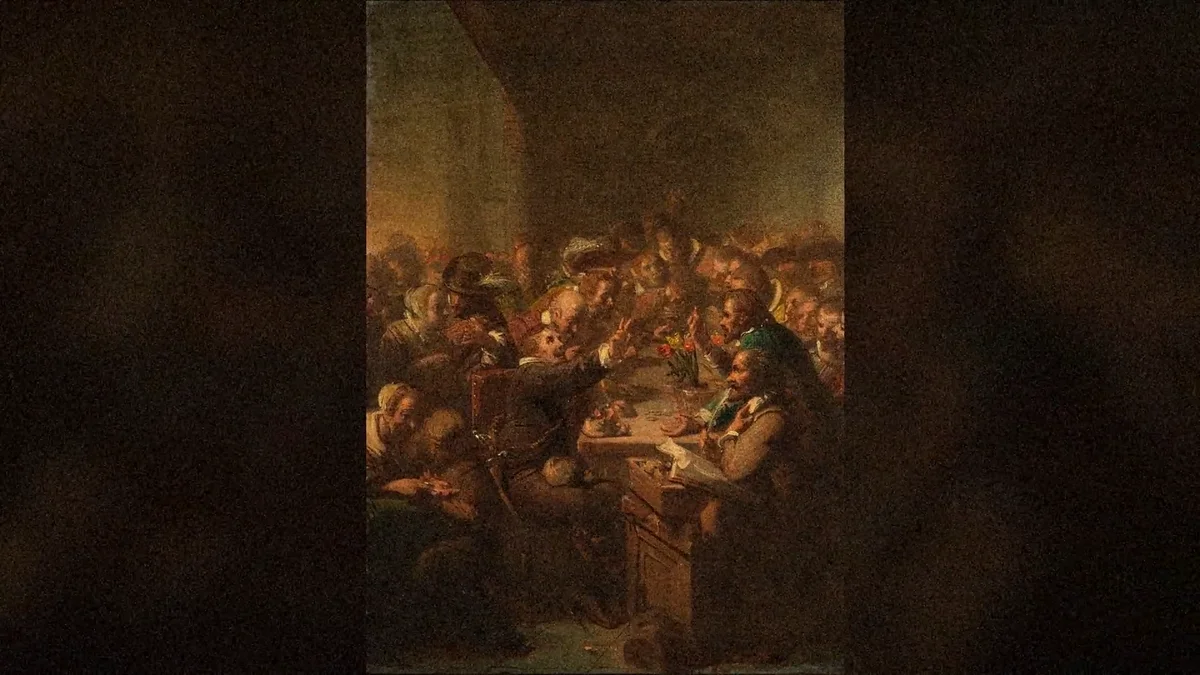
By the mid-1630s, a new group of traders, called florists, began buying and selling these contracts. They met in the back rooms of taverns, in groups called “colleges,” with their own rituals and fees. A buyer paid a small “wine money” charge on each deal. No one put down a deposit, and contracts were private agreements between individuals, not deals guaranteed by any exchange.
The Dutch had a name for this: the windhandel, the “wind trade,” because what was being traded was essentially air. A buyer might sign a contract for a bulb he never saw, then sell that contract on to someone else at a higher price, who sold it again. In the winter of 1636 to 1637, some contracts reportedly changed hands as many as five times.
The Peak: Winter 1636 to 1637
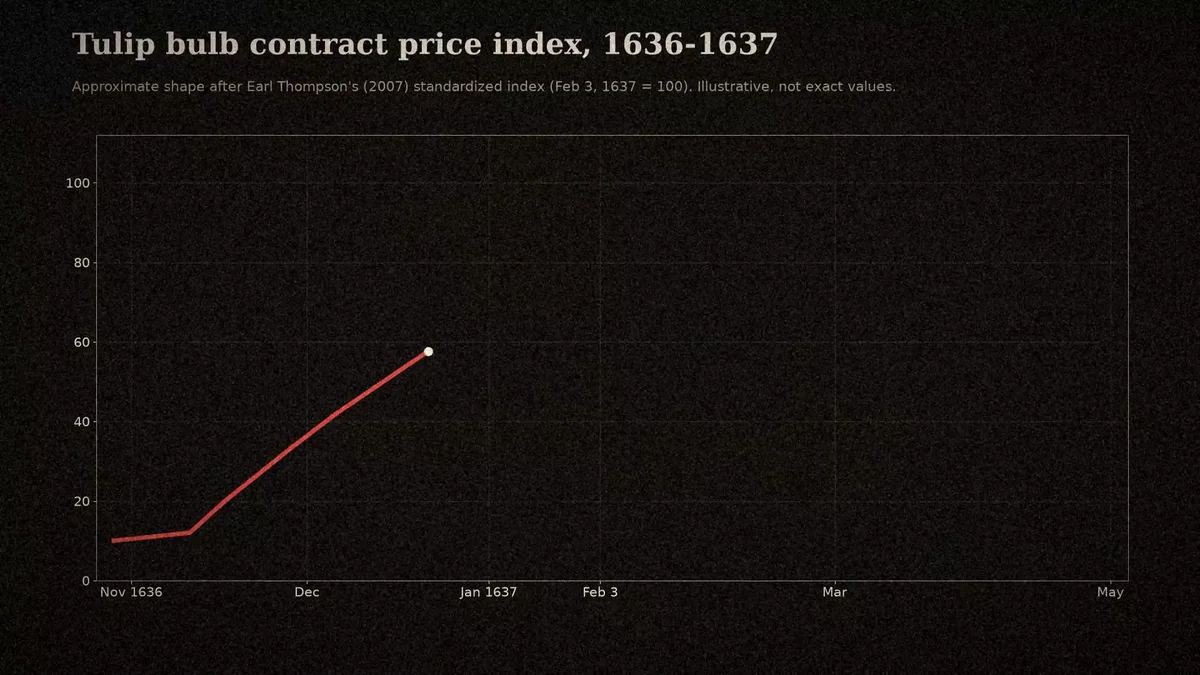
Prices for rare varieties had been rising for years. But around November 1636, something changed. Even common, single-colored bulbs—the kind sold by weight—started climbing steeply. Within weeks, contracts for ordinary bulbs were being quoted at many times their autumn prices.
The most famous single event came on the fifth of February 1637, in the town of Alkmaar. The collection of a deceased tavern keeper and grower, Wouter Winkel, was auctioned for the benefit of his orphaned children. According to records that historian Anne Goldgar examined, the sale raised around ninety thousand guilders. A single Viceroy bulb fetched over four thousand guilders. An Admirael van der Eijck went for over a thousand.
A famous pamphlet listed what a Viceroy was supposedly worth in ordinary goods: two lasts of wheat, four lasts of rye, four fat oxen, eight fat swine, twelve fat sheep, two barrels of wine, four tuns of beer, two tuns of butter, a thousand pounds of cheese, a complete bed, a suit of clothes, and a silver drinking cup. Total: two thousand five hundred guilders. It is a vivid list, but remember: it was written as satire.
The Crash in Haarlem
And then it stopped. According to a contemporary satire, the unraveling began in Haarlem around the third of February 1637, when an auctioneer could not find buyers, even after lowering the asking price again and again. Historians caution that the exact circumstances are not known. What is clear is that by the end of the first week of February, the buyers had vanished.
The trigger may have been as simple as fear. Haarlem was suffering a severe outbreak of plague in 1636 and 1637. Prices had risen so fast that there was no one left willing to pay more. Once the first buyer hesitated, everyone holding a contract realized that the price they had agreed was only real if someone, somewhere, would pay it.
On the seventh of February, florists met in Utrecht and chose representatives for a gathering in Amsterdam. Near the end of February, that meeting proposed a compromise: contracts made before December 1636 should be honored, while later ones could be canceled for a payment of ten percent of the price. The courts declined to rule and handed the problem back to the cities. In Haarlem, the city eventually allowed buyers to walk away for three and a half percent. In the end, most contracts were simply never fulfilled.
What the Data Actually Shows
The version of this story most people know comes from an 1841 book, Extraordinary Popular Delusions and the Madness of Crowds, by the Scottish journalist Charles Mackay. He described a nation in the grip of madness, with ordinary people selling their possessions and ruined speculators everywhere. For more than a century, almost no one checked.
Then economists did. In 1989, and in his book Famous First Bubbles, Peter Garber gathered every price he could find: 161 bulb sales of 39 varieties between 1633 and 1637. He noticed that many of those numbers came from a single satirical pamphlet, the Dialogues between Waermondt and Gaergoedt, and that the data mixed very different kinds of sales. In his words, the figures were “a blend of apples and oranges.”
Garber argued that high prices for rare bulbs were not crazy at all. New, unique flower varieties often start extremely expensive and then fall as they multiply—a pattern he also found in hyacinths a century later. The truly bizarre spike, he said, was in common bulbs, during a few weeks of winter, which he described as essentially a drinking game played in taverns during a plague.
In 2007, economist Earl Thompson offered another explanation. He pointed out that in late 1636, Dutch officials were already discussing a rule that would turn futures contracts into something like options, where a buyer could walk away for a small fee. If buyers expected they would only owe a few percent if prices fell, paying a very high headline price looked much less risky. In Thompson’s analysis, the extreme prices partly reflect that change in the contracts, not pure madness.
The Myth and the Moral
The historian Anne Goldgar spent years in Dutch archives reading the actual contracts, court cases, and notary records. Her conclusion was striking. The trade involved a fairly small group, mostly well-off merchants and skilled craftsmen, not the poor. And among the many buyers and sellers she could identify, she found fewer than half a dozen who had financial trouble at the time, with no clear evidence that tulips were to blame.
That makes sense once you remember how the trade worked. Very little money had actually changed hands. Profits were on paper, and so were losses. The Dutch economy kept growing. What was shaken was something else: trust, honor, and the idea that value could be known. Goldgar argues that this cultural shock, amplified by moralizing pamphlets and later copied and exaggerated, is what turned a short, local crisis into a legend.
So was Tulip Mania a bubble? Prices for some contracts clearly rose and collapsed with astonishing speed. But the popular story of a nation ruined by flowers is mostly myth. The real lesson may be about information itself: how a few satirical pamphlets, repeated for centuries, became the history everyone thought they knew.
Timeline
| Date | Event |
|---|---|
| 1593 | Carolus Clusius takes a post at the University of Leiden and plants tulips in its botanical garden. |
| Mid-1620s | Nicolaes van Wassenaer reports that the owner of a Semper Augustus refused an offer of thousands of guilders for a single bulb. |
| Mid-1630s | Florists begin buying and selling delivery contracts in tavern “colleges.” |
| November 1636 | Even common, single-colored bulbs start climbing steeply. |
| Winter 1636–1637 | Some contracts reportedly change hands as many as five times. |
| c. 3 February 1637 | A contemporary satire says an auctioneer in Haarlem cannot find buyers. Historians caution that the exact circumstances are not known. |
| 5 February 1637 | The Wouter Winkel collection is auctioned in Alkmaar. Goldgar’s reading of the records: the sale raised around 90,000 guilders. |
| 7 February 1637 | Florists meet in Utrecht and choose representatives for a gathering in Amsterdam. |
| Late February 1637 | The Amsterdam meeting proposes honoring contracts made before December 1636 and allowing later ones to be canceled for 10% of the price. |
| 1841 | Charles Mackay publishes the traditional “nation gone mad” account. |
| 1989 | Peter Garber gathers 161 bulb sales of 39 varieties between 1633 and 1637. |
| 2007 | Anne Goldgar’s Tulipmania and Earl Thompson’s contract-as-option analysis are published. |
Sources
- Anne Goldgar, Tulipmania: Money, Honor, and Knowledge in the Dutch Golden Age (University of Chicago Press, 2007).
- Peter M. Garber, “Tulipmania,” Journal of Political Economy 97(3), 1989, pp. 535–560.
- Peter M. Garber, Famous First Bubbles: The Fundamentals of Early Manias (MIT Press, 2000).
- Earl A. Thompson, “The tulipmania: Fact or artifact?” Public Choice 130, 2007, pp. 99–114.
- Charles Mackay, Memoirs of Extraordinary Popular Delusions and the Madness of Crowds (1841), for the traditional account.
- Mike Dash, Tulipomania (1999).
- Anna Pavord, The Tulip (1999).
Disclaimer: This article is for educational and historical purposes only. Nothing in this content should be construed as financial, investment, or trading advice. Tulipnomics provides historical storytelling and analysis—we are not financial advisors. Always consult with qualified professionals before making any financial decisions.